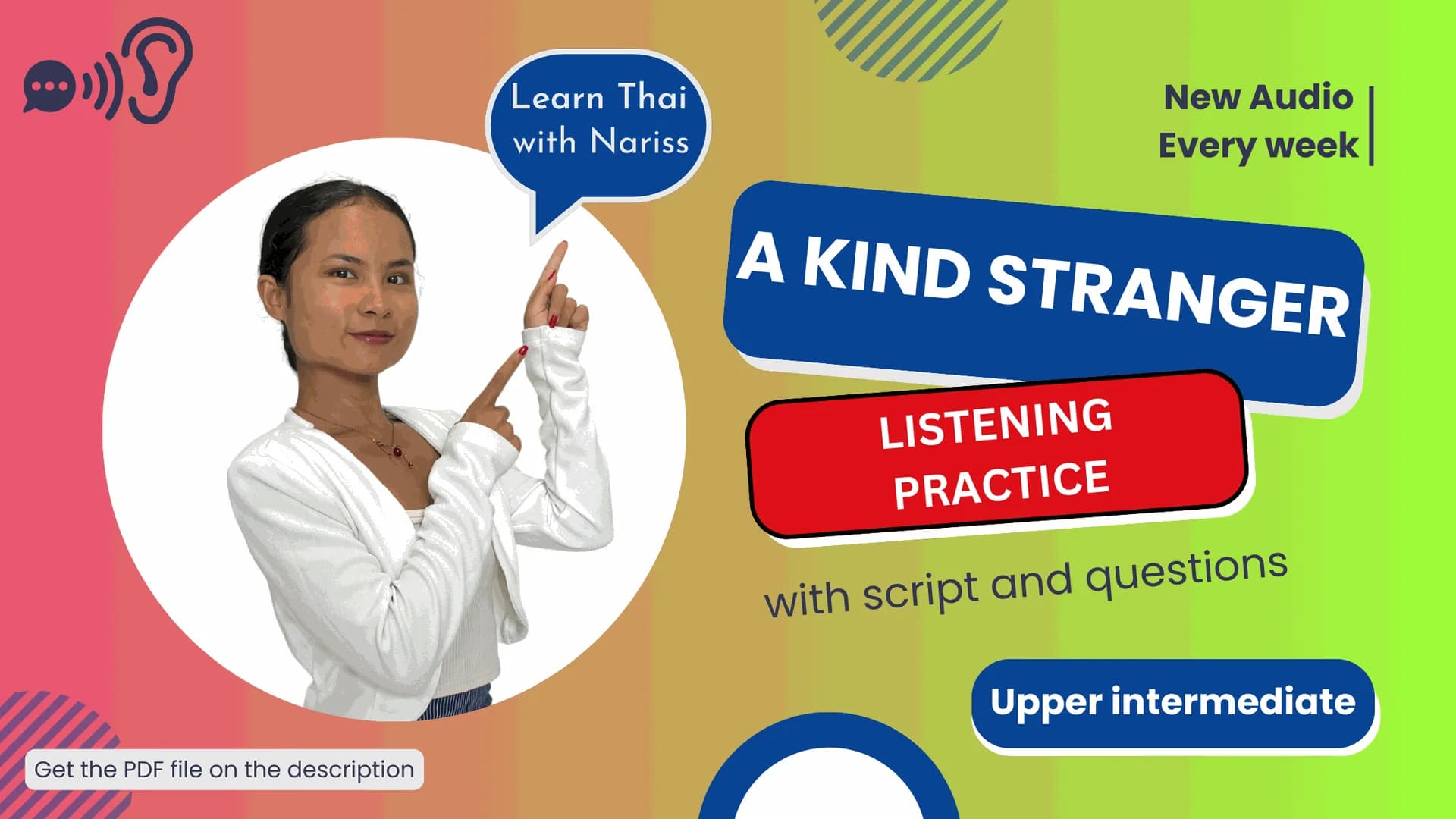
This upper-intermediate listening exercise tells the story of a man whose car breaks down during a winter storm, and the stranger who stops to help. It is a short narrative packed with useful vocabulary for describing weather, unexpected situations, and past events.
You will also practice a key grammar pattern: ในช่วงที่ (nai chûang thîi), meaning “during the time that.” This structure shows up constantly in Thai storytelling and everyday conversation. Listen to the audio, then work through the script and exercises below.
Romanization
Réue-duu nǎao thîi láew, nai chûang thîi mii phaa-yú raeng
Rót khǎwng John sǐa bon thà-nǒn thîi glai jàak thúk-yàang
Aa-gàad nǎao mâak, dtìt-lób nèung ong-sǎa
Khǎo mâi rúu wâa khuan tham yang-ngai dii
Chôk dii thîi mii khon-bplàek-nâa yùd rót láe chûay John
Khon-bplàek-nâa khon nán, mâi dâi khâe chûay John sâwm rót, dtàe phaa khǎo bpai phák thîi rong-raem thîi yùu glâi thîi-sùd jàak thîi-nîi dûay jon-gwàa phaa-yúu jà yùd
John rúu-sèuk chôk-dii mâak thîi mii khon maa chûay, phró àad-jà mii an-dtà-raai gèrd-khêun gàb khǎo nai kheun nán, dooi thîi mâi mii khrai rúu loey...
English Translation
“Last winter, during a strong storm,”
“John's car broke down on a road far from everything.”
“The weather was very cold, close to minus one degree.”
“He didn't know what to do.”
“Luckily, a stranger stopped his car and helped John.”
“That stranger didn't just help John fix the car, but took him to stay at the nearest hotel from here too, until the storm would stop.”
“John felt very lucky that someone came to help, because something dangerous could have happened to him that night, without anyone knowing...”
Vocabulary Focus
| Thai | Pronunciation | English |
|---|---|---|
| คนแปลกหน้า | khon-bplàek-nâa | stranger |
| ฤดูหนาว | Réue-duu nǎao | winter |
| พายุ | Phaa-yú | storm |
| รถเสีย | Rót sǐa | car broken down |
| อากาศหนาว | Aa-gàad nǎao | cold weather |
| โชคดี | Chôk dii | lucky |
| โรงแรม | Rong-raem | hotel |
คนแปลกหน้า
khon-bplàek-nâa
stranger
ฤดูหนาว
Réue-duu nǎao
winter
พายุ
Phaa-yú
storm
รถเสีย
Rót sǐa
car broken down
อากาศหนาว
Aa-gàad nǎao
cold weather
โชคดี
Chôk dii
lucky
โรงแรม
Rong-raem
hotel
Grammar Focus: ในช่วงที่ (nai chûang thîi)
The phrase ในช่วงที่ means “during the time that.” Thai speakers use it to set the scene before describing what happened. It works like a frame around a moment in time, and you will hear it in news reports, personal stories, and casual conversation alike.
| Thai | Pronunciation | English |
|---|---|---|
| ในช่วงที่มีพายุแรง | Nai chûang thîi mii phaa-yú raeng | During the time that there was a strong storm. |
| ในช่วงที่ฉันเรียนมหาวิทยาลัย | Nai chûang thîi chán rian ma-hǎa-wít-tha-yaa-lai | During the time that I was studying at university. |
| ในช่วงที่รถติด | Nai chûang thîi rót dtìt | During the time that there was a traffic jam. |
| ในช่วงที่ฝนตกหนัก | Nai chûang thîi fǒn dtòk nàk | During the time that it was raining heavily. |
| ในช่วงที่ฉันไม่อยู่บ้าน | Nai chûang thîi chán mâi yùu bâan | During the time that I wasn't home. |
ในช่วงที่มีพายุแรง
Nai chûang thîi mii phaa-yú raeng
During the time that there was a strong storm.
ในช่วงที่ฉันเรียนมหาวิทยาลัย
Nai chûang thîi chán rian ma-hǎa-wít-tha-yaa-lai
During the time that I was studying at university.
ในช่วงที่รถติด
Nai chûang thîi rót dtìt
During the time that there was a traffic jam.
ในช่วงที่ฝนตกหนัก
Nai chûang thîi fǒn dtòk nàk
During the time that it was raining heavily.
ในช่วงที่ฉันไม่อยู่บ้าน
Nai chûang thîi chán mâi yùu bâan
During the time that I wasn't home.
Practice Tips
- Play the audio once without looking at the script. Focus on picking out the vocabulary words: คนแปลกหน้า, พายุ, โชคดี. Note which ones you recognized.
- On a second listen, follow along with the romanization. Pay attention to the rhythm of longer sentences, especially the final line.
- Try building three sentences of your own using ในช่วงที่. Describe moments from your own week: during the time you were at work, during the time it rained, during the time you were cooking.
- Cover the English translation and see how much of the story you can reconstruct from the romanization alone.
Looking for structured lessons that build on exercises like this one? Nariss's video courses cover listening, speaking, and grammar from beginner to advanced. Or continue practicing with another story: Talking About Cooking.